I Spent a Year on Opal, Forest, and One Sec.
Then I Built emberglow.
A founder's honest comparison of the four most-recommended digital detox apps in 2026, including the one I built.
By Thomas Shellberg, Founder of emberglow~8 min read

The moment I stopped pretending I had it figured out
I was sitting on the couch after my kids got home from school, glued to my phone.
Technically, I was working. I was researching content creators in the digital wellness space, looking for people who might help spread the word about my app launch. So I told myself this wasn't doomscrolling. This was productive screen time.
Meanwhile, my kids were getting loud. Rowdy. Post-school chaos.
Instead of leaning into their energy, I got irritated. Every shout pulled me out of my phone and snapped my attention. The more they made noise, the more I dug in. Just five more minutes. Just one more thing.
Eventually I realized what was actually happening. They didn't need me to manage them. They needed me to be there. So I opened the app I was building, set a 60-minute quest, and called it “Play with my kids.” I locked my phone. If I unlocked it before the timer ran out, my hero would lose the chapter.
The mental shift was almost immediate. The open loop closed. The research could wait. My new job was helping run a Play-Doh bakery.
I ended up keeping my phone away for almost two hours.
This isn't a story about willpower. I'd been trying to fix this problem for over a year, and I'd tried just about every digital detox app on the market. None of them worked for me. This is the post I wish I'd read before I downloaded the first one.
TL;DR: How the four apps compare
| App | Core mechanism | Best for | Where it falls short | Pricing |
|---|---|---|---|---|
| Opal | Blocks apps and websites during focus sessions | People who want hard, enforceable blocking | Punitive framing that is easy to resent and bypass | Freemium with premium tier |
| Forest | A virtual tree grows while you're away; dies if you leave | Casual reduction, students, gentle nudge | The stakes are too low once the novelty wears off | Cheap one-time / freemium |
| One Sec | Adds a breathing pause before you open distracting apps | Building mindful awareness of your taps | Doesn't change why you reach for the phone | Freemium with premium tier |
| emberglow | Rewards time off your phone with a narrative RPG that progresses while you're offline | People who've tried punishment apps and bounced off them | Newer than the others; full story is paid | Freemium with paid story tier |
If you only read this far: each of those apps is good at something specific. None of them solved the problem for me, and the reason is the same across all three. I'll get to that.
App #1, Opal: blocking as a service
What Opal gets right:Opal is the most polished, well-designed blocking app on the market. The UI is beautiful. The “deep focus” mode that prevents you from disabling the block is genuinely helpful. If your problem is “I open Instagram and lose 40 minutes,” Opal's hard block will stop that bleeding.
Where Opal failed me:I'd schedule a 90-minute deep focus session, get blocked from Twitter, and then immediately feel resentful. I started to see Opal as the obstacle between me and what I wanted. The willpower fight just shifted from “should I open Twitter?” to “should I bypass Opal?” After a few weeks I started turning it off in advance, which defeats the point.
The deeper problem: blocking apps treat the symptom. The symptom is “I keep opening Twitter.” The cause is “I'm understimulated, anxious, or avoiding something.” Opal doesn't address the cause. It just makes the symptom harder to act on.
You should probably use Opal if:you want enforceable blocking and you're disciplined enough not to fight the system. It's the best in its category.
App #2, Forest: the cute pet you can't kill
What Forest gets right:Forest is charming. The conceit (plant a virtual tree, it grows while you're away, it dies if you leave the app) is one of the most-copied behavioral hooks in the App Store for a reason. It works on a small scale. The “donate to plant real trees” angle is a nice extra layer of meaning.
Where Forest failed me:Forest works for short sprints (a 25-minute Pomodoro, a study session). It does not work for the actual problem most of us have, which is the rest of our day. After about a month, I noticed I was killing the tree without flinching. The guilt loop deflates fast once you've broken a few. There's no progression, no story, no reason to come back besides the same low-stakes loop.
It's also not really a “digital detox” app. It's a focus timer. Useful, but a different category than what I needed.
You should probably use Forest if:you want a low-cost, low-commitment way to add gentle friction to short focus blocks. It's a starter app, not a long-term solution.
App #3, One Sec: the friction nudge
What One Sec gets right:One Sec is the most intellectually honest app of the three. It doesn't try to block you or shame you. It just makes you take a breath before opening Instagram. That one-second pause is enough to break the muscle memory of the unconscious tap. As a tool for self-awareness, it's excellent. I still recommend it to people who say “I don't even know I'm doing it.”
Where One Sec failed me:Awareness isn't the same as change. After a couple of weeks I was awarethat I was opening Instagram 80 times a day, and I kept doing it. The pause became part of the ritual rather than a circuit breaker. One Sec is a great diagnostic. It's not a treatment.
You should probably use One Sec if:you genuinely don't know how often you reach for distracting apps and you want to build an honest baseline. Combine it with something else for actual reduction.
The pattern I couldn't stop seeing
After about a year of cycling through these apps, I noticed something. They all share the same theory of change:
Make phone use harder, more annoying, or more shameful, and you'll do less of it.
Opal blocks you. Forest guilts you. One Sec inconveniences you.
Punishment-based behavior change works for a few days, sometimes a few weeks. Then one of two things happens. You adapt around it (turn off the block, kill the tree, tap through the pause). Or the friction starts to feel hostile, and you uninstall the app. Either way, you end up back where you started, with a slightly worse opinion of yourself.
The thing my kids needed wasn't for me to feel bad about my phone. They needed me to feel good about not being on it.
That's a completely different problem. And as far as I could tell, no one was solving it.
What I built instead
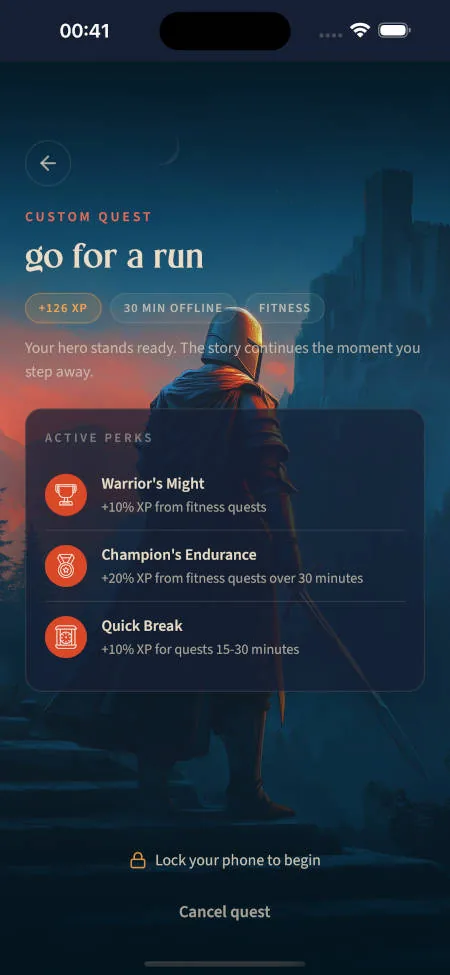
Set a real-world quest
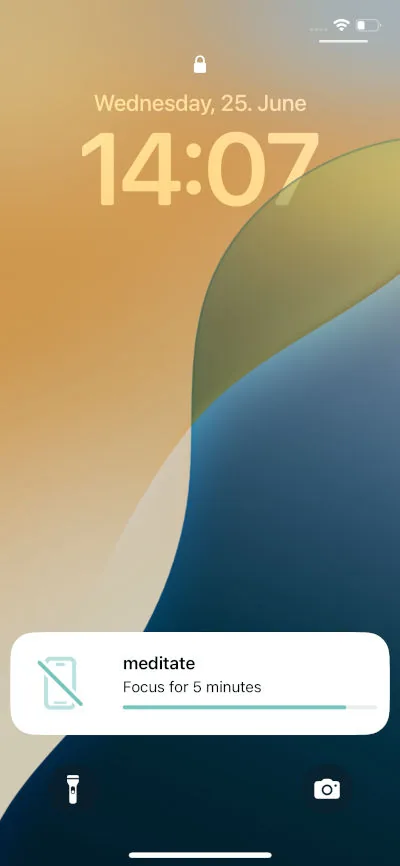
Lock the phone
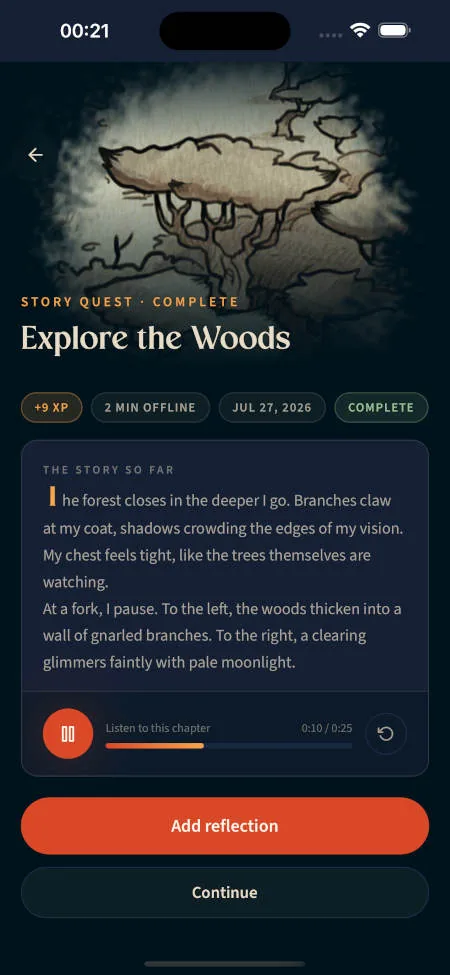
Return to your story
emberglow is a phone-down RPG. You set a quest in the real world: “play with my kids,” “go for a walk,” “read for 30 minutes,” “have a conversation without checking anything.” You lock your phone. While you're away, your hero in a hand-painted fantasy world called Vaedros levels up, makes choices, and walks deeper into a branching story.
When you come back to your phone, you don't get a punishment screen or a dead tree. You get the next chapter of the story you've been building. You hear the narration. You see what your hero did while you were busy being a person.
The mechanism is simple, but the inversion is the point:
- Opal punishes screen-on time. emberglow rewards screen-off time.
- Forest's tree dies if you fail. emberglow's quest just slips away. The story is still there when you're ready to try again.
- One Sec interrupts your taps. emberglow gives you a reason not to need them.
The reason this matters: motivation built on reward is durable. Motivation built on punishment depletes. After three months of using emberglow, I'm not white-knuckling my way through phone-free time. I'm looking forward to it because I want to know what happens next in the story.
Where emberglow falls short (the honest part)
I'm not going to pretend emberglow is the right answer for everyone. A few honest notes:
- If you need hard blocking, Opal is better. emberglow doesn't prevent you from opening Twitter. It just gives you a reason not to want to. If your willpower is currently zero, start with a blocker.
- If you want minimalism, One Sec is lighter. emberglow has art, narration, character progression, story branches. Some people find that delightful. Some people find it like another thing to manage. Be honest with yourself about which you are.
- The full story is paid. The first chapters are free, but going deep into Vaedros requires a subscription. I have to pay the writers and narrators. If you want a fully free option, Forest is cheaper.
- It's newer.Opal, Forest, and One Sec have years of polish behind them. I'm still ironing things out. If you need something rock-solid in 2026, it'll be more solid in 2027.
Who emberglow is actually for
If any of these sound like you, I think it's worth a try:
- You've tried punishment-based detox apps and bounced off them
- You like games, stories, RPGs, or any system where progress accrues over time
- You want a reason to put your phone down that isn't shame
- You're a parent who wants to be more present and is tired of feeling like a hypocrite
- You're a creative or builder whose best work happens when you're not in your phone
- You're recovering from burnout and harsh productivity culture has not been kind to you
If none of those describe you, that's fine. The other apps in this comparison are good at what they do. Use the one that matches your actual problem.
What I learned from a year of this
The digital detox category is built on a quiet assumption: that the way to spend less time on your phone is to make your phone worse. Block it. Time it. Shame it. Pause it.
I think that assumption is wrong. The way to spend less time on your phone is to make the time off your phone better.
That doesn't mean you need an app to do it. Walk outside. Call someone. Pick up an instrument. The best digital detox is the one that gives your attention somewhere meaningful to land.
But if you're like me, if you've been promising yourself you'll put it down for years and you keep failing, sometimes a story helps. Sometimes a quest helps. Sometimes you need a hero who's waiting for you to come back to the real world so they can take their next step.
That's what I built. I built it for me first. I hope it helps you too.
Thomas
Founder, emberglow
Glad you're here.



Pick a hero. Put your phone down.
emberglow is available on iOS and Android. The first quests and the opening of the story are free.

FAQ
Is emberglow free?
The first chapters of the story and basic quests are free. Full story access is a subscription. There are no ads.
Does emberglow block apps like Opal does?
No. emberglow uses a quest timer that detects if you unlock your phone. If you do, the quest fails, but the only consequence is that your hero doesn't progress. There's no hard system-level block.
Does it work on Android?
Yes. emberglow is available on both iOS and Android. You can grab it from the App Store or Google Play.
How is this different from Forest?
Forest is a focus timer with a virtual tree. emberglow is a long-form narrative RPG with branching stories, hand-painted art, voice narration, and character progression that builds over months of use. Forest is great for a study session. emberglow is built for the long haul.
Does it really work?
For me, yes. I went from 6+ hours of phone screen time per day to under 2 hours, and I'm calmer and more present with my family. Your mileage may vary. The people it works best for are the ones who've already tried punishment apps and want a different approach.
Last updated: April 2026. I refresh this comparison quarterly. If you spot something inaccurate about a competitor (pricing change, feature update, anything), let me know on the Discord and I'll fix it.
All posts